


Jagannath Rath Yatra: The Moving Sanctuary and the Universal Horizon
By Vinay Nalwa
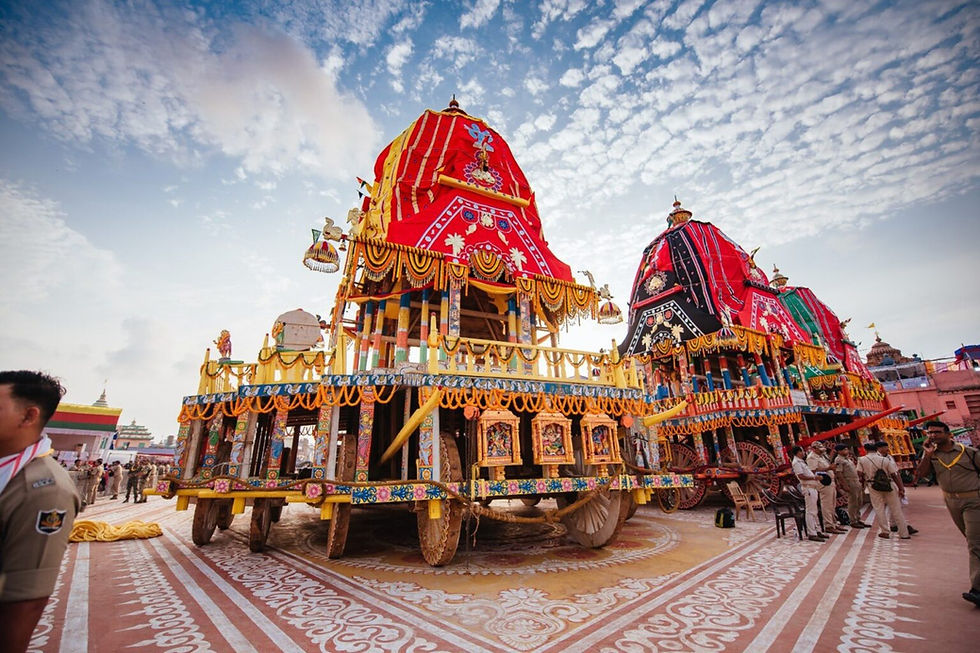
Today July 24, 2026 is the final day of the core chariot procession phase, known as Bahuda Yatra. The divine return journey of Lord Jagannath, Lord Balabhadra, and Goddess Subhadra from the Gundicha Temple back to the main Shree Jagannath Temple in Puri. As this grand return brings the annual procession to its culmination, it invites us to contemplate how this unique festival fundamentally reimagines the very essence of sacred space and spiritual encounter.
Most sacred places around the world are built around stillness. You travel across oceans, climb mountains, or trek across continents just to stand in front of a quiet, unmoving shrine. The temple stays put and you do the moving.
But once a year in Puri, in the Indian state of Odisha during the Rath Yatra, that whole idea gets turned on its head. The temple doesn't wait for you, it comes out to the street.
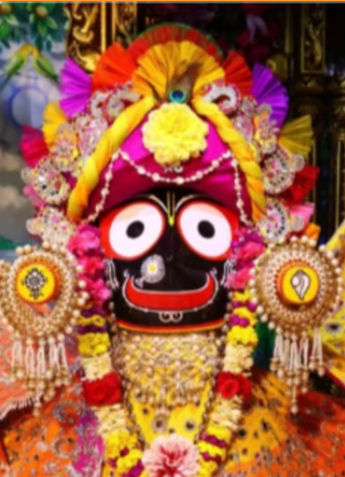
When Lord Jagannath, His elder brother Balabhadra, and sister Subhadra leave the main sanctum and board those giant wooden chariots on the Badadanda, it sends a simple but powerful message. The message is If humanity cannot always reach the Divine, the Divine will step out onto the dusty thoroughfare to meet humanity.
While traditional temple worship demands formal purity, strict entry protocols, and internal pilgrimage, the Rath Yatra establishes the principle of Patita Pavana (the supreme upliftment of all). On the Badadanda(giant road), social hierarchies, distinctions, and institutional boundaries dissolve instantly. Anyone, regardless of lineage, background, or belief can see, touch, and pull the thick ropes of the Nandighosha, Taladhwaja, and Darpadalana.
This radical openness is precisely why the Rath Yatra has transcended its geographic origin in Odisha to become a globally resonant spiritual movement. Today, the moving sanctuary of Puri finds its echo in major cities across the globe. The sight of massive wooden chariots moving down 5th Avenue in New York, through Trafalgar Square in London, along Golden Gate Park in San Francisco, or through the bustling streets of Tokyo, Moscow, and Sydney is a living testimony to the universalism of Bharatiya thought.
The underlying philosophy Vasudhaiva Kutumbakam (the world is one family)is not proclaimed through abstract theory, but demonstrated in action as thousands of people of diverse nationalities and cultures pull a single rope together in unison.
Beyond the Misunderstood "Juggernaut"
Historically, when early European travelers in the 14th through 18th centuries first witnessed the chariot procession in Puri, they were bewildered by its sheer scale and fervor. Franciscan missionary Friar Odoric of Pordenone (c. 1321) recorded one of the earliest Western accounts, describing an "idol placed upon a chariot, most richly dressed... drawn by many thousands of people." Centuries later, in May 1633, English quartermaster William Bruton marvelled at what he called the "White Pagoda," detailing the massive wooden car of "great height and bulk" moving through immense crowds. (European Travelers in India (15th-17th Centuries, E F Oaten)
By the late 17th century, French physician François Bernier (Travels in the Mogul Empire, 1656–1668) and Portuguese friar Sebastião Manrique both documented how hundreds of thousands gathered along the Bada Danda, mesmerized as the living deity emerged from the temple gates. Later, Scottish sea captain Alexander Hamilton (A New Account of the East Indies, 1727) recorded the spectacle of an idol placed upon a "huge machine or carriage of forty or fifty feet high, drawn by thousands of people."
The roaring gongs, the thunderous chanting, and the irresistible movement of three giant wooden chariots through an ocean of devotees left an indelible mark on the Western imagination. From their attempts to transliterate Jagannātha, the word "Juggernaut" entered the English language—initially used by 18th-century writers to describe a massive, unstoppable physical force.
Yet, what those early foreign observers mistook for mere physical momentum was, in reality, a spiritual momentum. The true "Juggernaut" of Puri is the unstoppable force of collective devotion and human unity—a force that sweeps away the artificial barriers constructed by ego, privilege, and social division.
The Journey to the Maternal Origin
There is a subtle psychological brilliance in the geography of the Yatra itself. The chariots do not travel toward a palace of victory or a monument of power; they travel three kilometers down the road to the Gundicha Temple—symbolizing the deities' return to their place of origin, their aunt’s home.
In this journey lies a deep spiritual metaphor for modern life. In our relentless pursuit of material accumulation, complexity, and status, our inner self often becomes alienated from its true nature. The trip to Gundicha is a journey back to simplicity, warmth, and spiritual origin. It reminds us that no matter how complex the architecture of our outer lives becomes, the ultimate destiny of the soul is to return to the embrace of pure, unconditioned love.
The Collective Pull of Consciousness
To hold the rope of Lord Jagannath’s chariot is to participate in an ancient, unbroken continuity of human hope. As the wooden wheels turn upon the earth, they carry a timeless message for a fragmented world: that the highest spiritual truth is accessible to all, that power must bow to service, and that the ultimate sanctuary is found wherever human hearts unite in humility and love.
As the chariots roll forward this year, they carry not just the wooden forms of the Lord of the Universe, but the moving sanctuary of human consciousness itself—rolling steadily toward a horizon where every soul finds its home.
(The writer is an author and political analyst)


Comments