


The Yellow 'H': The Forgotten Hindu Holocaust of 1971
By Vinay Nalwa
The word 'holocaust' comes from the Greek holokauston, a sacrifice wholly consumed by fire. In modern history, it refers to the systematic, state-sponsored persecution and murder of six million European Jews by Nazi Germany and its collaborators between 1933 and 1945. The Jews call it the Shoah, the catastrophe.
On November 1, 2005, the United Nations General Assembly adopted resolution 60/7, designating January 27 as the International Day of Commemoration in memory of the victims of the Holocaust. The resolution recalls that the Holocaust "resulted in the murder of one third of the Jewish people".
It was the horror of the Holocaust that led the United Nations to adopt the Convention on the Prevention and Punishment of the Crime of Genocide on December 9, 1948. Article II defines genocide as acts "committed with intent to destroy, in whole or in part, a national, ethnical, racial or religious group, as such." What set the Holocaust apart was not only the scale of the killing but its method. The state identified a people by its faith, marked it, hunted it, and destroyed it on orders.
Twenty-three years after the Convention was adopted, the same pattern appeared in East Pakistan, and this time the victims were Hindus.
"General Niazi visited my unit at Thakargaon and Bogra. He asked us how many Hindus we had killed. In May, there was an order in writing to kill Hindus. This order was from Brigadier Abdullah Malik of 23 Brigade."
These were the words of Lt. Col. Aziz Ahmed Khan, Commanding Officer of 8 Baluch and later of 86 Mujahid Battalion of the Pakistan Army, while deposing before the Hamoodur Rahman Commission in 1974.
The general he spoke of was Lt. Gen. A.A.K. Niazi, commander of the Pakistani forces in East Pakistan, who surrendered in Dhaka on December 16, 1971.
The Commission which recorded this testimony was set up by the Government of Pakistan itself and was headed by the Chief Justice of Pakistan. Its report remained a secret for 26 years. This evidence of an organised killing of Hindus does not come from India or Bangladesh. It comes from the officers of the very army which carried out the killings.
Even today, when Hindus in Bangladesh celebrate Durga Puja under assurances of security from their government, 1971 explains the depth of their fear.
It was not the first time. On October 10, 1946, the day of Kojagori Lakshmi Puja, when Bengali Hindu families light their homes and worship Maa Lakshmi, mobs fell upon Hindu villages in Noakhali and neighbouring Tippera. "A huge mob gave us the ultimatum to join Islam or be burnt," a Hindu correspondent wrote. Villages were attacked, houses burned, and women carried off. A telegram from Chaumuhani on October 17 reported that murder, looting, arson and conversion were continuing: "Unconverted people are being slaughtered on a mass scale. No help is available from the local authorities." Women, to escape dishonour, "jumped into fire and many took poison and some committed suicide by hanging," reported the Hindustan Standard. Six months later, in April 1947, Congress workers in Noakhali were still reporting "attempts to burn Hindus alive".
On the night of March 25, 1971, the Pakistan Army launched Operation Searchlight to crush the Bengali movement that followed the Awami League's election victory. The Hindus, 18.5 per cent of East Pakistan's population in 1961, were to become its special target.
It must be noted that the Commission was not sympathetic to Bangladesh. It blamed the Awami League for "the initiative in resorting to violence and cruelty" and accepted the army's own count of about 26,000 dead. Yet among the allegations it examined, it listed one separately: "Deliberate killing of members of the Hindu minority."
The officers who appeared before it confirmed the charge. Lt. Col. Mansoorul Haq told the Commission, "There was a general feeling of hatred against Bengalis amongst the soldiers and officers, including Generals. There were verbal instructions to eliminate Hindus." When the army moved into the villages and small towns, he said, "It moved ruthlessly, destroying, burning and killing." A man picked up on suspicion was "sent to Bangladesh", the army's code for "death without trial". Lt. Col. Aziz Ahmed Khan said Brigadier Arbab had told him "to destroy all houses in Joydepur", and "to a great extent I executed this order."
Women were not spared. Among the allegations before the Commission was the rape of "a large number of East Pakistani women by the officers and men of the Pakistan army as a deliberate act of revenge, retaliation and torture." Niazi himself had written to his formations in April 1971 that "loot, rape, arson, killing of people at random must stop", an admission that all of it was taking place. The Commission found "some evidence to suggest that the words and personal actions of Lt. Gen. Niazi were calculated to encourage the killings and rape." It also concluded that "the attitude of the Army authorities towards the Hindu minority also resulted in large-scale exodus to India."
What these officers admitted in 1974 had been recorded by an American lawmaker in 1971. In his report to the US Senate Judiciary Subcommittee on Refugees, dated November 1, 1971, Senator Edward Kennedy wrote, "Hardest hit have been members of the Hindu community who have been robbed of their lands and shops, systematically slaughtered, and in some places, painted with yellow patches marked 'H'." A US government report prepared for Kennedy recorded about 9.8 million refugees in India by November 15, 1971, 93 per cent of them Hindus.
Sydney Schanberg, the New York Times correspondent, toured Bangladesh by road a month after the war ended. "In town after town there was an execution area where people had been killed by bayonet, bullet and bludgeon." At these sites, he added, "blood-stained clothing and tufts of human hair clung to the brush at these killing grounds. Children too young to understand were playing grotesque games with skulls. Other reminders were the yellow 'H's the Pakistanis had painted on the homes of Hindus, particular targets of the Muslim army."
A community marked on its doors, a written order to kill its members, a general asking his men for the count, and millions driven out of their homes. This is precisely what the Genocide Convention describes as acts committed with intent to destroy a religious group "as such". The yellow "H" of East Bengal recalls the yellow star which Nazi Germany forced upon the Jews. Yet the Hindu holocaust of 1971 is rarely called by its name.
Nobody was ever punished. The Commission recommended a high-powered court to try those responsible. But the 195 officers named by Bangladesh as war crimes suspects went home under the 1974 tripartite agreement, and no trial was ever held.
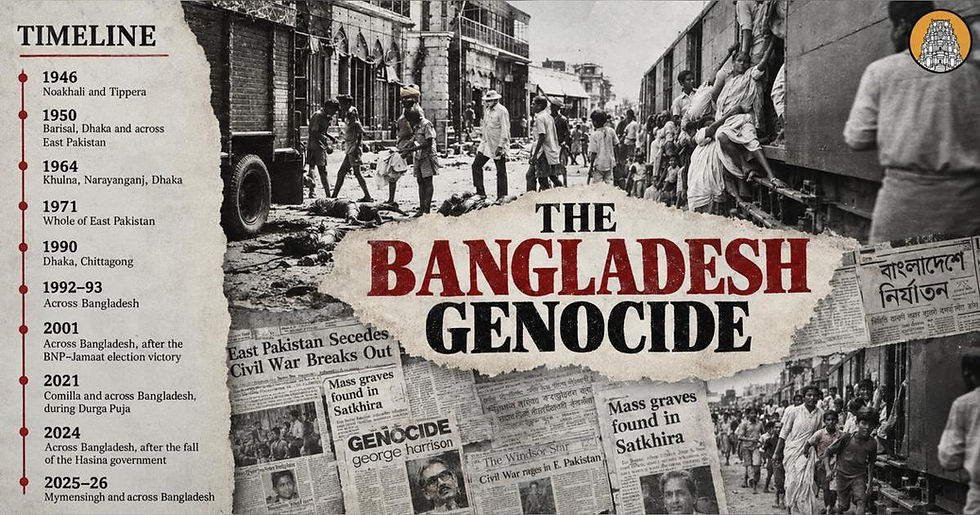
Impunity has its own cost. Noakhali and 1971 are not isolated chapters but part of a long chain of violence against Hindus in this land, which continues to this day:
Violence against Hindus in East Bengal and Bangladesh, 1946–2026
Year | Where | What happened | Source |
1946 | Noakhali and Tippera | Began on Kojagori Lakshmi Puja. Killings, forced conversions and abduction of women; 75,000 Hindus driven into relief camps. | |
1950 | Barisal, Dhaka and across East Pakistan | Massacres of Hindus; nearly 1.7 million fled to India between December 1949 and November 1950. | |
1964 | Khulna, Narayanganj, Dhaka | Around 5,000 Hindus killed in Khulna district; in Narayanganj about 3,500 killed, 300 women abducted and 31,000 homes destroyed. | |
1971 | Whole of East Pakistan | Written and verbal orders to kill Hindus; homes marked with a yellow "H"; 9.8 million refugees, 93 per cent of them Hindus. | |
1990 | Dhaka, Chittagong | Temples attacked across the country; at least 300 Hindu houses burned around the Kaibalyadham temple in Chittagong. | |
1992–93 | Across Bangladesh | Violence after the Babri demolition continued until March 1993, causing the death of hundreds. | |
2001 | Across Bangladesh, after the BNP–Jamaat election victory | 355 murders and 3,270 other incidents of rape, arson and looting documented by a judicial commission. | |
2021 | Comilla and across Bangladesh, during Durga Puja | At least seven killed; temples vandalised and dozens of Hindu homes torched. | |
2024 | Across Bangladesh, after the fall of the Hasina government | 2,010 incidents between August 4 and 20; nine killed, 69 places of worship attacked, four women raped. | |
2025–26 | Mymensingh and across Bangladesh | Dipu Chandra Das lynched and his body set on fire (December 2025); 257 incidents and 44 killings in the first half of 2026. |
The census tells the same story. Hindus were 28 per cent of the population of the area in 1941, 18.5 per cent in 1961 and 13.5 per cent in 1974, according to census figures. By 2022, they were 7.95 per cent.
It is truly sad that, in spite of suffering of this magnitude, only a few voices are raised, once in a while, to remind humanity of it. The world has rightly resolved never to forget the Holocaust. The Hindus of Noakhali, of 1971 and of every riot since deserve no less. Their story must be heard, it must be addressed, and justice must be served.
The Hamoodur Rahman Commission had itself written, "No amount of provocation by the militants of the Awami League or other miscreants could justify retaliation by a disciplined army against its own people." Every January 27 the world remembers the victims of the Holocaust. For the Hindus of East Bengal, whose homes were marked with a yellow "H" and whose killing was ordered in writing, the silence has lasted more than half a century.


Comments