


When a Sacred Symbol Is Misread: From Classroom Stigma to Grassroots Action Across the Diaspora
By Vinay Nalwa
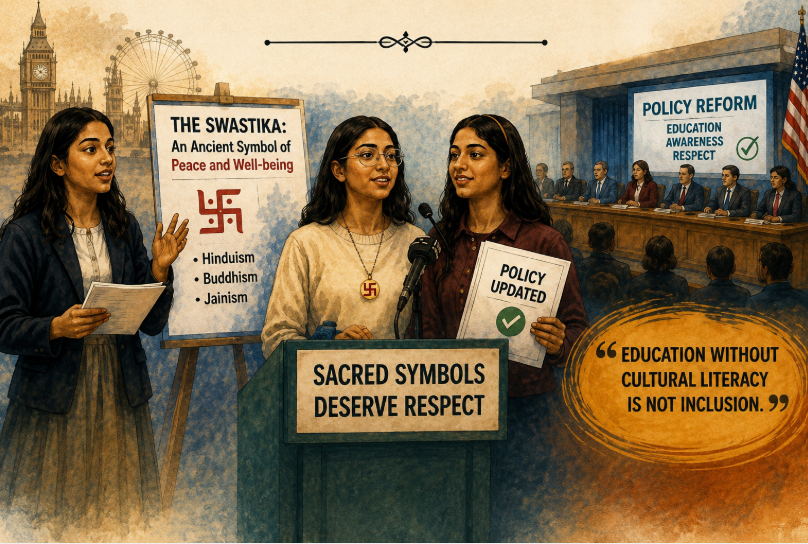
Earlier this year, a report by Insight UK concerning an eight-year-old Hindu pupil at Vicar’s Green Primary School in London deeply unsettled many within the global Hindu diaspora. The child was repeatedly questioned by school staff simply for wearing a Tilak-Chandlo, a traditional sacred mark on the forehead. This persistent friction eventually led to social withdrawal, removal from positions of responsibility, and ultimately his departure from the school.
While the incident appeared, at first glance, to be a localized administrative dispute over school policy, it pointed to a far deeper institutional failure: a severe lack of cultural literacy in environments that otherwise profess a commitment to diversity and inclusion. What was exposed there was not misconduct by a young student, but the inability of authority figures to interpret visual markers of faith with nuance and understanding.
Having observed the diaspora’s navigating of pluralistic societies over the years, it is clear that true inclusion often falters at the altar of institutional convenience. In many Western institutions, "diversity" is celebrated only when it conforms to familiar aesthetic norms; the moment a practice requires genuine historical engagement, it is too easily misread through a lens of suspicion.
This phenomenon is far from an isolated anomaly. A 2023 briefing by the Henry Jackson Society titled Anti-Hindu Hate in Schools revealed that over half of Hindu parents surveyed reported their children had experienced anti-Hindu prejudice in UK schools, frequently stemming from misunderstandings surrounding religious symbols. In the UK, schools operate under legal frameworks designed to prevent this very harm. The Equality Act 2010 explicitly safeguards individuals from discrimination based on religion or belief, requiring public authorities to foster good relations between communities. Yet, when uniform or appearance regulations are enforced mechanically without cultural sensitivity, these legal safeguards become hollow. The burden of explanation falls unfairly on young children and their parents, forcing pupils into defensive positions to justify practices integral to their identity.
However, recent reports from across the Atlantic demonstrate that this narrative is entering a decisive new chapter. Rather than suffering in silence, Hindu students in the United States are actively challenging institutional ignorance and transforming classroom misunderstandings into concrete policy reform.
In New Jersey, 15-year-old Mira Trivedi’s campaign began after an eighth-grade social studies lesson where her teacher categorized the swastika strictly as a hate symbol linked to Nazi Germany. Having grown up seeing the swastika during Hindu religious ceremonies as an ancient marker of well-being, peace, and auspiciousness, Trivedi approached her teacher to explain its deep Eastern heritage. Informed that curriculum changes required administrative action, she took her case directly to the school board, ultimately persuading them to educate 35 teachers on the crucial distinction between the ancient sacred swastika used in Hinduism, Buddhism, and Jainism, and the Nazi Hakenkreuz (hooked cross).
A parallel effort unfolded in Maryland’s Howard County Public School System, where students Saisha Vyas and Priya Bakshi challenged rules that prohibited Bakshi from wearing a necklace featuring the sacred symbol. Preparing educational materials and engaging directly with school officials and local Jewish groups, their advocacy resulted in a policy update affecting nearly 50,000 students—specifically banning the Nazi Hakenkreuz while protecting the right to display sacred religious symbols.
These US developments underscore what sociologists refer to as "context collapse"- a phenomenon where sacred iconography, central to the lives of millions, is viewed exclusively through the prism of Western historical trauma. As Pushpita Prasad of the Coalition of Hindus of North America (CoHNA) noted, this confusion extends into adulthood, with professionals facing workplace HR reports or police inquiries simply for displaying sacred symbols during festivals or remote video calls.
Derived from su- (“auspicious”) and asti (“it exists”), the Sanskrit svastika (स्वस्तिक) is a timeless invocation: "may good presence prevail." For millennia across Dharmic traditions, it has remained an emblem of cosmic order and well-being, an ancient heritage that stands in sharp, tragic contrast to its modern Western distortion.
Crucially, the student advocates driving these changes have made it clear that distinguishing sacred iconography from hate speech does not mean ignoring the horrific trauma of the Holocaust or Nazi persecution. Instead, it demands that educational systems respect intent, origin, and context.
Watching these young students step up provides a compelling study in contrast: where school boards and administrators hesitated out of fear or ignorance, the children themselves showed the courage and clarity needed to bridge complex cultural divides. The trajectory from the painful incident in London to the legislative and policy victories in New Jersey and Maryland demonstrates that the diaspora's youth are no longer willing to accommodate institutional illiteracy. By demanding precise terminology and context, they are ensuring that future generations can carry the living symbols of their heritage with dignity, confidence, and without fear of stigma.



Comments